When certain restrictions are implemented in a game, the player's first reaction is often not "Does this rule make sense?" but rather "Why has a feature I was using just a moment ago suddenly disappeared?"
The recent age verification controversy encountered by players in the UK in Minecraft feels exactly like this. According to the plan announced by Xbox last year, adult users in the UK logging in with a Microsoft account who have not completed age verification will lose access to full social features starting in early 2026. Features that are usually taken for granted—text chat, voice communication, and game invites—will be restricted to friends only.
This leads to the problem. For many players, Minecraft has never been just a single-player block game. Its most vibrant aspects lie in the openness of servers, friends, impromptu groups, community events, and building alongside strangers. Now, with an age verification rule imposed, the game remains, the save files are still there, and purchase history and achievements are intact, but the most vital social pipeline has suddenly narrowed. Naturally, players are unhappy.
What makes this even more sensitive is that this isn't a sudden whim of Minecraft itself, but part of a push driven by the UK's Online Safety Act. Platforms must prove they can provide a safer online environment for minors, and Xbox is required to adjust its account system according to regional regulations. From the platform's perspective, this logic is not hard to understand: children must be protected, adults must be distinguished, and social features must have different permissions based on age.
However, from the player's perspective, another question is equally valid: Why must I hand over more personal information to a verification system just to keep chatting? The official stance is that the verification is a one-time process, emphasizing that the relevant information is encrypted using industry standards and will not be used for other purposes. The problem is that trust is never automatically generated by a promise alone. Especially when age verification involves identity proof, facial estimation, mobile carrier checks, or credit card verification, many people instinctively feel uneasy.
This is why discussions on how to bypass these restrictions appeared in the community so quickly. There is no need or reason to spread specific methods here, as that would only distract from the core issue; what is truly worth examining is why players reached this point so quickly. On the surface, they are resisting chat restrictions. On a deeper level, they are resisting a feeling: that game companies, regulators, and third-party verification services have suddenly stood in front of their accounts, demanding proof of identity before allowing them to play as they did before.
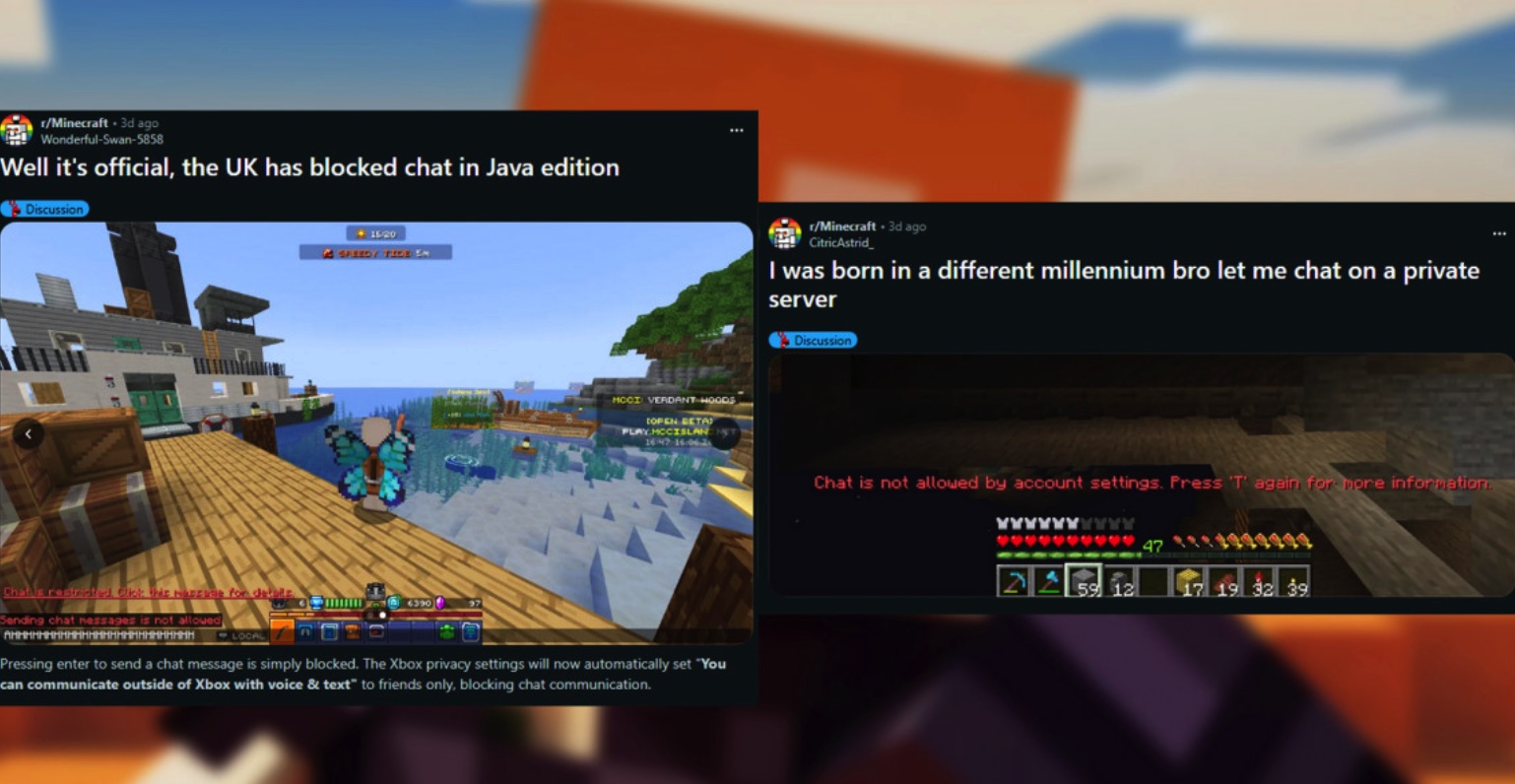
This resistance is not surprising. Over the past year, controversies surrounding age verification and online safety rules in the UK have been constant. Some support stricter protection for minors, while others worry that such practices will push ordinary users toward greater privacy risks. Especially after data security incidents related to age verification have been reported on other platforms, players are becoming more cautious about "who they entrust their personal identity to." Protecting children is certainly important, but adults are also asking: is the cost of this protection designed too crudely?
The most awkward part is that Minecraft happens to be a game where policy contradictions are easily amplified. Its player base spans a wide range, from elementary school students to long-time players who have been working for years. It is also highly dependent on community interaction, where the experience on many servers is even more important than official content. When age verification blocks social capabilities at the system level, players don't just see it as a small account pop-up; they see it as a wall standing in the middle of their gaming culture.
Of course, the platform has its own difficulties. Protecting minors is not just a slogan; if something goes wrong, the responsibility won't fall solely on the players. For a global platform like Xbox, compliance, parental trust, and regulatory pressure are all very real costs. It cannot pretend that risks don't exist, nor can it rely solely on player self-discipline. In a sense, age verification is not a matter of whether it wants to do it, but an issue that online services can increasingly no longer avoid.
But this does not mean the current experience is without flaws. A truly good security mechanism shouldn't just focus on "closing the door"; it should also ensure users clearly understand what they are handing over, to whom, how long it will be kept, and who is responsible if something goes wrong. If all players see are locked features, recurring prompts, and unsettling verification methods, then even the most legitimate security goals will erode trust through the user experience.
Not to mention that gaming communities are inherently prone to finding loopholes. The more rigid, sudden, and poorly explained a restriction is, the easier it is to provoke a rebellious reaction from players. Many people may not actually oppose protecting minors; what they resent is a set of rules being imposed on them without being made to feel respected. For the platform, this is the most dangerous aspect: you think you are building security, but players feel they are being treated as default suspects.
Therefore, what truly stings about this controversy is not that a few feature buttons are temporarily missing, but that future game accounts may increasingly resemble extensions of real-world identities. In the past, players entered a server needing only a name, a skin, and some shared playtime; in the future, players in certain regions may need to pass age, location, and identity verification before gaining full social permissions. Technically, this may be more controllable, but emotionally, it makes many people feel that the gaming world is no longer as carefree as it once was.
Ultimately, Minecraft being caught up in age verification is just a microcosm of a larger trend. Protection for minors will become stricter, platform compliance will become more granular, and privacy anxiety among players will grow. No one can simply say that the other side is completely wrong, but if a protection mechanism eventually forces players to look for ways to bypass it, it at least shows that it hasn't truly solved the issue of trust.
I personally believe that what is most worth discussing is not "whether players should be verified," but "whether the platform has made the verification sufficiently credible, transparent, and non-intrusive to normal gameplay." Children need protection, but adults shouldn't be forced to choose between privacy and their gaming experience. Can you accept age verification for full chat functionality? Or, as long as it involves identity information, is your subconscious reaction to stay away?