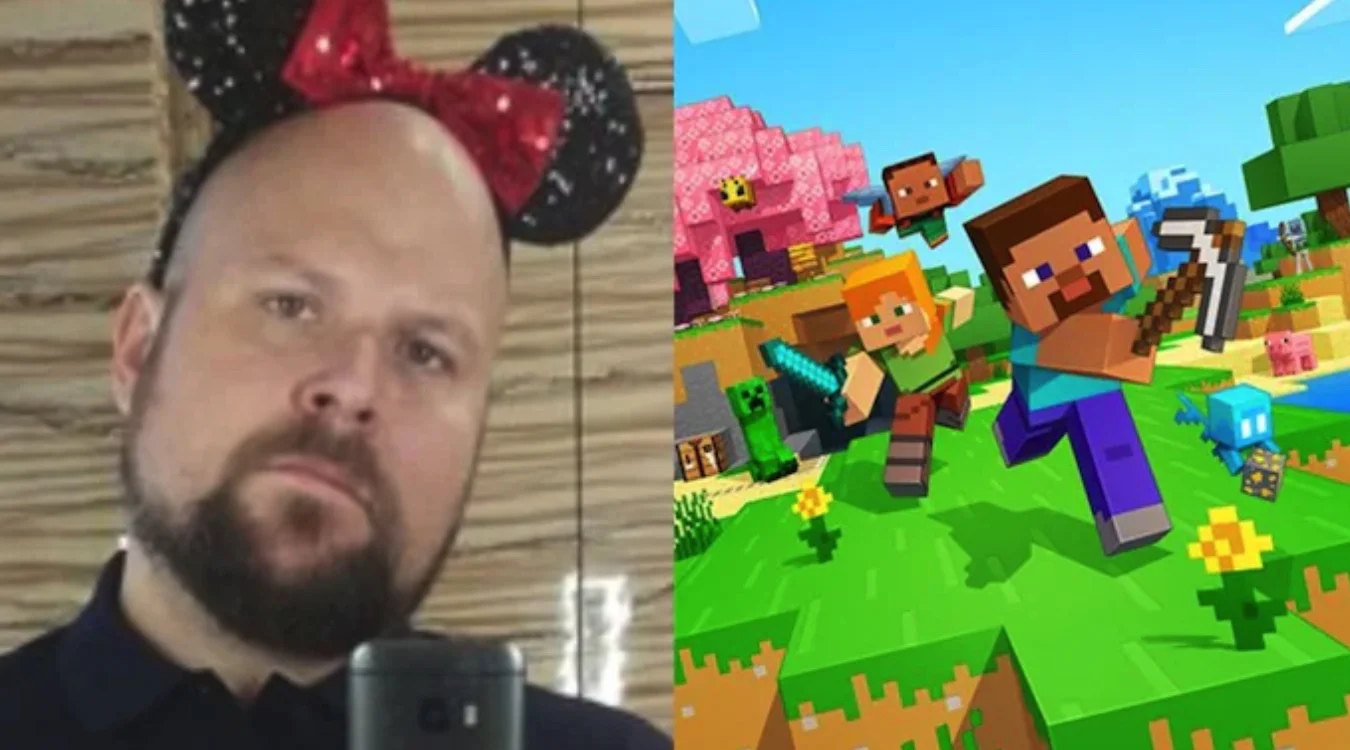
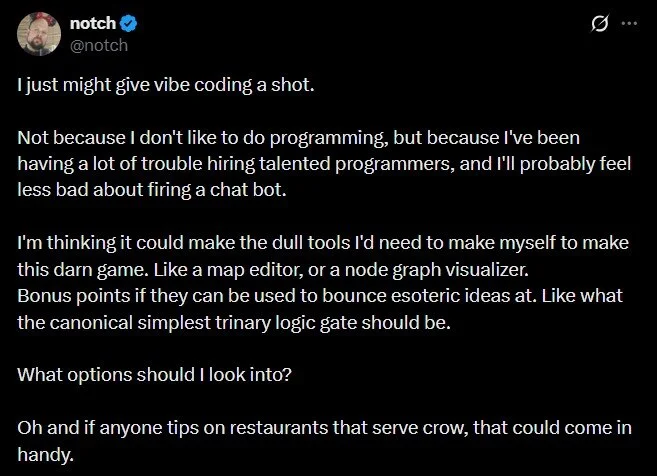
The recent remarks by Markus “Notch” Persson, the creator of Minecraft, sting not because he plans to use AI to write code, but because of his reasoning: he cannot find enough high-quality programmers, and if he ever needs to stop a collaboration, firing a chatbot won’t make him feel guilty.
This statement sounds somewhat harsh, carrying the kind of dark humor common in developer circles. However, it sparked immediate discussion precisely because it brought a reality many are reluctant to voice directly to the table: as AI Agents begin to take on more work, the first thing companies compare is not who writes with more creativity, but who is cheaper, more stable, and easier to replace.
Notch mentioned he intends to try Vibe Coding. This term has become increasingly common over the past two years. Simply put, it means humans no longer write every line of code from scratch; instead, they provide requirements, ideas, and functional boundaries to a model, which then generates, modifies, and completes the code. Developers are shifting from being "the ones laying the bricks" to "the ones staring at blueprints, constantly overseeing revisions and quality control."
This certainly does not mean that programming will disappear overnight. Truly complex software is not just about stitching a few pages together: requirements must be accurate, architecture must be maintainable in the long term, data security must be upheld, someone must decide how to handle production incidents, and understanding what users actually need remains a human responsibility. The issue is that a prototype that once required five people to build can now perhaps be pushed forward by one person with a few AI tools; a feature that once took two weeks to validate might now have a demo-ready version in a single afternoon.
Efficiency gains are never a bad thing; what is truly unsettling is that efficiency dividends are often used as a justification for cutting labor costs. When managers see that AI can write interfaces, fill in tests, organize documentation, and fix simple bugs, they easily reach a blunt conclusion: if machines can do it, why keep so many people? But the speed of code generation and the ability to take responsibility for the results are two different things. Confusing the former with the latter is the trap most teams are likely to fall into next.
Notch’s status makes this particularly symbolic. In 2009, he created Minecraft, which later grew into one of the most successful games in the world. In 2014, he sold Mojang and Minecraft to Microsoft for approximately $2.5 billion. In 2024, he founded a new studio, Bitshift Entertainment, and is currently developing a new game titled Levers and Chests.
For someone who once changed the gaming industry through creativity and code to now openly discuss using AI tools to handle his development work is more impactful than any hyperbolic poster about "AI replacing programmers." This is not the judgment of an outsider, but the perspective of someone who has created a phenomenal work and is still attempting to build new games.
Even more intriguing is that not long ago, Notch wrote in a social media post: "No to AI." A few days later, he admitted that while he might feel uncomfortable about it for now, how long can he resist what he sees as an inevitable change? This wavering is not uncommon. Many creators and developers feel the same way about AI: they are wary of it swallowing the space for originality, yet they cannot ignore the speed and cost advantages it brings.
This contradiction is also playing out in the broader job market. Recently, the tech industry has continued to adjust its workforce; companies like Amazon, Oracle, and Meta have all implemented layoffs while pouring massive amounts of capital into AI. The gaming industry is not faring any better: Microsoft’s Xbox division has undergone restructuring, affecting some game development roles, and other major gaming companies have reported similar layoffs.
Therefore, when people hear statements like "firing a chatbot won't make me feel guilty," the backlash isn't just about the tone. People are worried that the costs that should be borne by management failures, poor project judgment, and industry cycles will be easily shifted onto ordinary employees under the guise of "AI efficiency." When a person is replaced, it is not just a name missing from an organizational chart; it involves the loss of income, accumulated experience, and a sense of professional future.
Some describe this shift as "the era where programmers no longer write code." Linux founder Linus Torvalds' attitude toward AI has also sparked debate, while Node.js creator Ryan Dahl previously expressed a more radical view, suggesting that the era of humans writing code by hand is coming to an end. Similar viewpoints will continue to emerge, but none should be interpreted as a simple conclusion that human developers are useless.
A more accurate statement might be: low-barrier, highly repetitive, and rule-based coding tasks will be swallowed by tools faster and faster; meanwhile, those who can define problems, decompose complex systems, understand business consequences, and take responsibility for final quality will become even more important. However, this "increased importance" does not mean everyone will transition naturally. Some will use AI to amplify their capabilities, while others will feel the pressure as roles shrink.
What is truly worth being vigilant about is not whether developers need to learn to use AI, but whether we have begun to default to the idea that as long as a machine can complete a task, a human should be promptly cleared out. Technology may be emotionless, but organizations should not lose their judgment of people because of it. AI-generated code can be deleted at any time, but when a developer is laid off, they lose far more than just a commit history.
Notch’s transformation acts as an uncomfortable mirror: we look forward to tools saving us time, yet we fear becoming the part that gets saved. Do you think AI will make excellent developers freer, or will it make the threshold for "excellence" even more brutal?